
Here are 20 of the most iconic and breathtaking cosmic photographs ever taken, drawn from Hubble Space Telescope, James Webb Space Telescope (JWST), and other landmark missions. These images have transformed our understanding of the universe and captured the public imagination.
I’ve ranked them roughly by cultural/scientific impact and visual awe, based on consensus from NASA/ESA archives and astronomy sources. Direct embedding isn’t possible here, but I’ve included official links where you can view high-resolution versions.


Signature: cGbj5JWAirJBMg1H8ntNo/s5RMerTcch5rU+Fu5O+rZH/jNSyrIXkohdTwn2YnZLU8irR4Csrs4+RTWJI+lReOnoQLn4JcP+HvPkERumLOg/741F9n0Jrq1HnCCExzsgchvObxg2eRHs1q7YHkwDCzuWmJYQv7QaUKdm5OahZrpipED5DuFnWeW+facz0gF+WmWMmaEZeL3y6ZIliO6cT+dAupx1sIeDvnR1giyG34XPbPLvcA9dalYDKnF8o6pThTlO013iyNKlldS7PIJWm0z43dLD5NkKpMJPamESLMjhG7LvQVqlVkuM8hWndPfEiybnw6F1QofzAic/VzJ0Av6TtXEDoVfJPrsFsr641oenpPEip+7wpUDUnJk21aBPI/Q44R05eRKcZbjPSuMVSyIA7IswLn+UzoARiVen6nMxTMdOHTJJZsSgH1YmFQS7yb190OzRcs5Bh7HIlV2q9J2zaYKHBveQXhTPzb2v5CCpsLscfIaxX9//B4zSkaduJ7/mEdYBFySrSF8U5IWjjluw+Uhv0uiLGjhWjNbyROpBWkn/sUZNJS7Xmtu+W5SuMqzoDQ+Yv1hrg5FMY1n8A7jxh7J2hDIBtYk8cZp0LnZjwiEjiYCtrfxxdgrvGbgLjWEKHc0bnEh7U6LscLqTClKWKeZyVqOoh8bib57dwuDdNI1uBAjsovJKgKOYIJNSaiGRsl8oQ64PqOV+032A0nnP311VW5mNMWaLKxyTLHmonCSTs3npr3phMfw3i/J7Kj/k30jU7EDdon5SXX3D2brU8G4T+zpnhX7lOB2qYahs9P3lYUAOZ5TZwaLNVEpP3XrOgVuRba6AaGHcLKYvmVB5f78O4XbqFoJHFIHO5sXLHU/Zr9ogGEUaX96P5KVDD1AhEkv5oNg7k5rXV8PbgLe8bORE7hCopuO28WapSqlP4wjLHFcFVgSACgJtFAYVvs4u3UL/+li+AxzBX0T6sdPRuUyP2xyIKm3h5kJIOe8=

Signature: PhM6hYxeFtLTq72r5YMbec5IwfEk/ckjyEvPUWAkO1DBZKbSof+7uRXnEHwgSmPmtuqjHjDP3t/4/P41mQDE94scJIR6RUmCPYo2LYRXTdlQWLeNaLsoW8dsnI1+zsbCAoT4yoHkKBf0I1VJV7evRN0aKTSXxuvkkBwUlsNeWcWUME3OaYKPkMjjUxJvn5waZAlJ1wQbHXhpw3YOBMMSHRWigWFvrSztqNRvLkmui23MKO4Mpxju0ceNZbN24Jv8zkG4klBx9GP04s1wEqo3iVEFCU+lBMu3xXWDddKvE+ZAgj358DDIIkX+gykBWOlYd6ou8ZtjYSVPNwhVdCTNN9oARmlCjZU4H3DIZF7+vU86LHNXLI4kE72pTzY4hevVEjhEnV/4Aen+lIqNJ+F7o0bezpNYzHn5eTEr3PEXTjvvxs8he6AM7wvSOqHIJtilktbbFhWQiWhkeOU+pjy9lVNDpKs2ZifWtSqajagQBKC1zhxqwRzsfVKtkm/tMa0g5n6QNxdPab7lJMtBiaePb8+5xvYkXAzbVYgm8qxtlBheAryuhvKocJIKw0d57PQYDVdOTWhDBtsEQVlWbCRLL4gYoEnqIvCAm4i0X0KqpmCVkceGS0lokcynGBgVekSHT/Hf1+LP6bHam79JxaPHa2vLyP961XaCWAhX/iAJa/81h+urFAFO5oTlSQ1QPs+fsRnribrbAR46IJLx9DU9a3PV1dzGd7ub7lThdCm08Ds4TceMFJOGrl7vDJMJWk9j9ujQCdjRyvXGgFUUgpIS64hTHXLQzFuKeTFlTqaqtjqcsw9i2K786IoP5aSTYOl4gPz4izU8zcVE6gnr9f7CFftCBhuYHpZ6W+NVtFP6RArLv2v12SDrQlEti9+O7wnHuaufF6N+wuCpxEQA/9BFvoLWHTeeeqNDHCCFXhTFhQOE8LNS8qDtY++qFOZQ/2eEuU9u5WfQE7PnLsEbBrfuwl59YRHZ20oo8pLTKE1VafU=

This celestial object looks like a delicate butterfly. But it is far from serene. What resemble dainty butterfly wings are actually roiling cauldrons of gas heated to nearly 20 000 degrees Celsius. The gas is tearing across space at more than 950 000 kilometres per hour — fast enough to travel from Earth to the Moon in 24 minutes! A dying star that was once about five times the mass of the Sun is at the centre of this fury. It has ejected its envelope of gases and is now unleashing a stream of ultraviolet radiation that is making the cast-off material glow. This object is an example of a planetary nebula, so-named because many of them have a round appearance resembling that of a planet when viewed through a small telescope. The Wide Field Camera 3 (WFC3), a new camera aboard the NASA/ESA Hubble Space Telescope, snapped this image of the planetary nebula, catalogued as NGC 6302, but more popularly called the Bug Nebula or the Butterfly Nebula. WFC3 was installed by NASA astronauts in May 2009, during the Servicing Mission to upgrade and repair the 19-year-old Hubble. NGC 6302 lies within our Milky Way galaxy, roughly 3800 light-years away in the constellation of Scorpius. The glowing gas is the star's outer layers, expelled over about 2200 years. The "butterfly" stretches for more than two light-years, which is about half the distance from the Sun to the nearest star, Proxima Centauri. The central star itself cannot be seen, because it is hidden within a doughnut-shaped ring of dust, which appears as a dark band pinching the nebula in the centre. The thick dust belt constricts the star's outflow, creating the classic "bipolar" or hourglass shape displayed by some planetary nebulae. The star's surface temperature is estimated to be over 220 000 degrees Celsius, making it one of the hottest known stars in our galaxy. Spectroscopic observations made with ground-based telescopes show that the gas is roughly 20 000 degrees Celsius, which is unusually hot compared to a t

To celebrate its 28th anniversary in space the NASA/ESA Hubble Space Telescope took this amazing and colourful image of the Lagoon Nebula. The whole nebula, about 4000 light-years away, is an incredible 55 light-years wide and 20 light-years tall. This image shows only a small part of this turbulent star-formation region, about four light-years across. This stunning nebula was first catalogued in 1654 by the Italian astronomer Giovanni Battista Hodierna, who sought to record nebulous objects in the night sky so they would not be mistaken for comets. Since Hodierna’s observations, the Lagoon Nebula has been photographed and analysed by many telescopes and astronomers all over the world. The observations were taken by Hubble’s Wide Field Camera 3 between 12 February and 18 February 2018.


Hubble Classics (1990s–2010s)
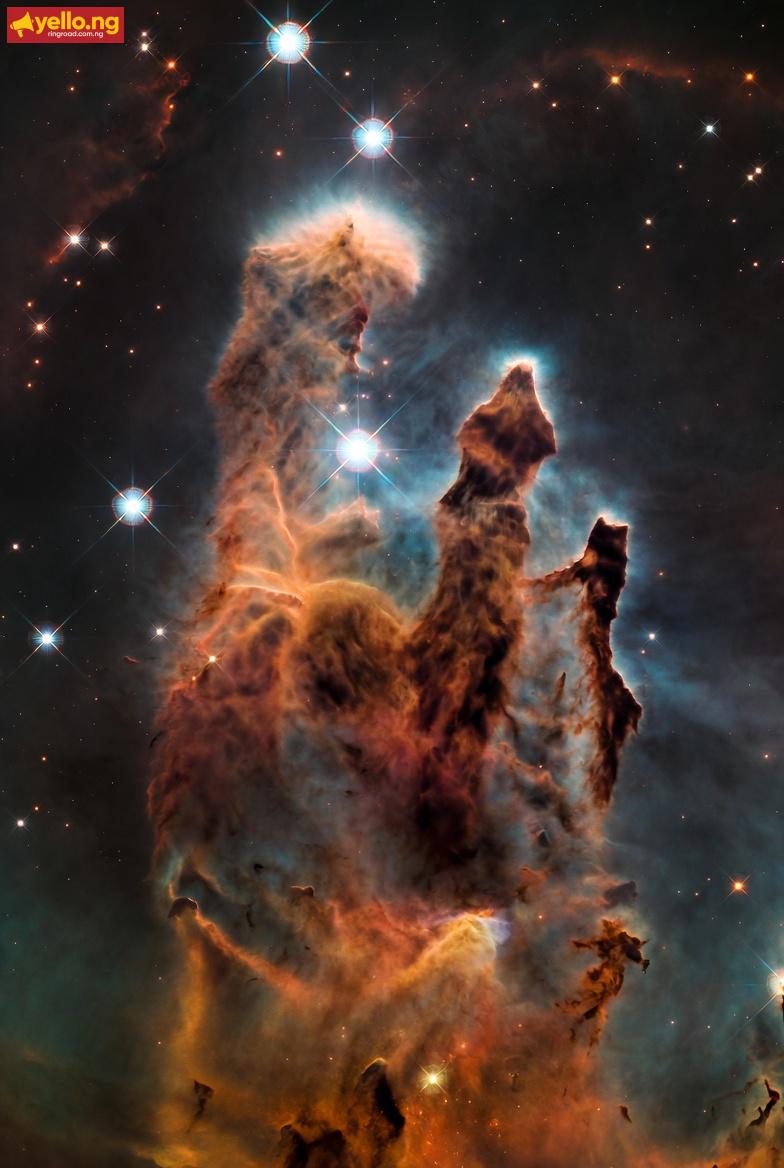
- Pillars of Creation (Eagle Nebula, 1995 & 2014) Towering columns of gas and dust where stars are born. One of the most famous space images ever. View: ESA Hubble Top Images
- Hubble Ultra Deep Field (2003–2012) A tiny patch of sky revealing over 10,000 galaxies, some from the early universe. Expanded our view of cosmic history. View: NASA/ESA archives.
- Antennae Galaxies (Interacting galaxies, best image ~2006–2010s) Dramatic collision of two galaxies sparking massive star formation. View: ESA Hubble.
- Crab Nebula (Most detailed view) Remnant of a supernova explosion, showing intricate filaments. View: ESA Hubble Top 100.
- Westerlund 2 Star Cluster (Hubble 25th anniversary image) Massive young stars illuminating gas clouds. View: NASA Hubble.
- Lagoon Nebula (Hubble 28th anniversary) Vibrant star-forming region with glowing gas. View: ESA Hubble Hall of Fame.
- Horsehead Nebula Iconic dark nebula silhouette against glowing hydrogen. Classic Hubble.
- Whirlpool Galaxy (M51) Stunning spiral galaxy with a companion, showing dust lanes and star-forming arms.
- Sombrero Galaxy (M104) Edge-on spiral with a bright bulge resembling a hat.
- Jupiter with Europa (2020) Hubble’s sharp view of the gas giant and its icy moon.
JWST Masterpieces (2022–present)
- Pillars of Creation (JWST infrared, 2022) JWST’s infrared view penetrates dust to reveal young stars inside the pillars. View: ESA Webb Top Images
- Carina Nebula – Cosmic Cliffs Dramatic “mountains” of dust and gas with newborn stars. One of JWST’s first releases. View: NASA Webb.
- Phantom Galaxy (M74) Face-on spiral galaxy showing intricate structure in infrared.
- Neptune and Rings JWST captured the planet’s faint rings and dynamic atmosphere brilliantly.
- Tarantula Nebula Massive star-forming complex in the Large Magellanic Cloud.
- Einstein Ring (Gravitational lensing) Perfect ring of light from a distant galaxy bent by gravity.
- Deep Field Views (JWST versions of Hubble Ultra Deep Field) Even deeper infrared look into the early universe.
Other Historic Cosmic Images
- Earthrise (Apollo 8, 1968) Earth appearing over the Moon’s horizon — changed humanity’s perspective on our planet.
- Pale Blue Dot (Voyager 1, 1990) Earth as a tiny speck in a sunbeam from 4 billion miles away. Carl Sagan’s famous reflection.
- Saturn with Rings (JWST + Hubble composites) Recent stunning infrared and visible light views highlighting ring structure and atmosphere.
Where to Explore More
- ESA Hubble Top 100: esahubble.org/images/archive/top100/
- ESA Webb Top 100: esawebb.org/images/archive/top100/
- NASA Hubble & Webb galleries for full-resolution downloads.
These images blend beauty with profound science — from star birth to the vastness of deep time. Which one is your favorite, or would you like me to expand on any specific image?