

Top stories
In Gallup’s latest poll released Tuesday morning, 49% approve of the job Trump is doing in office while 50% disapprove. Trump’s previous high was in April 2019 when he got to 46% approval in Gallup. The first poll Gallup conducted when Trump became president in January 2017 showed him at 45% approval.


Trump Job Approval at Personal Best 49%
STORY HIGHLIGHTS
- Approval among Republicans hits 94%
- Poll shows highest party polarization on record
- Half of registered voters say Trump deserves to be re-elected
WASHINGTON, D.C. — President Donald Trump’s job approval rating has risen to 49%, his highest in Gallup polling since he took office in 2017.
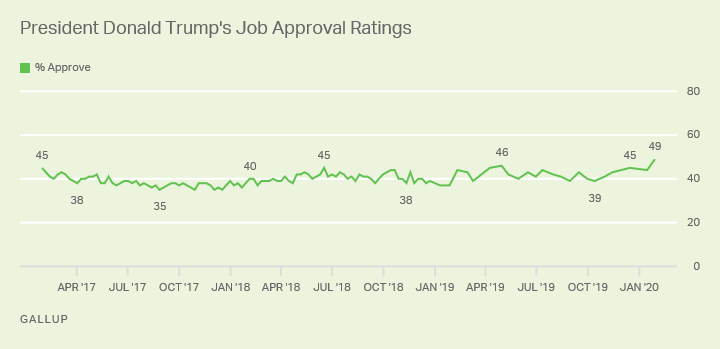
The new poll finds 50% of Americans disapproving of Trump, leaving just 1% expressing no opinion. The average percentage not having an opinion on Trump has been 5% throughout his presidency.
Trump’s approval rating has risen because of higher ratings among both Republicans and independents. His 94% approval rating among Republicans is up six percentage points from early January and is three points higher than his previous best among his fellow partisans. The 42% approval rating among independents is up five points, and ties three other polls as his best among that group. Democratic approval is 7%, down slightly from 10%.
The 87-point gap between Republican and Democratic approval in the current poll is the largest Gallup has measured in any Gallup poll to date, surpassing the prior record, held by Trump and Barack Obama, by one point.
The Jan. 16-29 poll was conducted in the midst of the Senate impeachment trial that will likely result in the president’s acquittal. The poll finds 52% of Americans in favor of acquitting Trump and 46% in favor of convicting and removing him from office.
In addition to possibly reflecting sentiment regarding his impeachment, Trump’s increased approval rating may also result from other issues, including:
- The recent military action in Iran. More Americans in the new poll approve (53%) than disapprove (45%) of the U.S. military action that resulted in the death of a leading Iranian military general. Iran retaliated but, despite fears of escalation, no further military action has been taken by either side.
- Foreign trade. During the poll’s field period, Trump also signed the United States-Mexico-Canada trade deal to replace the North American Free Trade Agreement.
- The economy. Americans’ confidence in the economy is higher than at any point in the past two decades. Similarly, national satisfaction is the highest in nearly 15 years.
Sixty-three percent of Americans now approve of the way Trump is handling the economy, up six points from the prior reading in November. It is the highest economic approval rating not only for Trump, but for any president since George W. Bush enjoyed stratospheric job approval ratings in the first few months after the Sept. 11, 2001, terrorist attacks.
Trump’s ratings for handling foreign affairs (47%) and foreign trade (50%) are also his best to date.
Republican Party Image Also Improving
As Trump’s job approval rating has improved, so has the image of the Republican Party. Now, 51% of Americans view the Republican Party favorably, up from 43% in September. It is the first time GOP favorability has exceeded 50% since 2005.
Meanwhile, 45% of Americans have a positive opinion of the Democratic Party, a slight dip from 48% in September.
Additionally, the poll finds 48% of Americans identifying as Republicans or leaning toward that party, compared with 44% Democratic identification or leaning. Recent Gallup polls had shown a fairly even partisan distribution, after the Democratic Party held advantages for much of 2019.
Gallup observed similar public opinion shifts when Bill Clinton was impeached.
- Clinton’s approval rating spiked to a personal high of 73% after the House impeachment vote, and stayed above his pre-impeachment readings through his acquittal by the Senate in early 1999.
- A seven-point average Democratic advantage in party identification and leaning in two early December 1998 polls (49% to 42%) swelled to an average 17 points (53% to 36%) in two late December polls after the Dec. 19, 1998, impeachment vote.
- The latest impeachment saga has had a different effect on party favorable ratings, however. When Clinton was impeached, favorable ratings of the Democratic Party were unchanged (but high, at 57% and 58% in two December polls), while the GOP’s ratings plummeted, falling from 43% pre-impeachment to an all-time low of 31% after the House vote to impeach.
Election Context
Impeachment and a strong state of the nation may have brightened Trump’s election prospects, but U.S. registered voters are evenly divided at 50% as to whether he deserves re-election. When the question was last asked, just before the 2018 midterm elections, 41% of Americans thought Trump deserved a second term.
With the Democratic nomination campaign fully underway, 39% of registered voters say they will vote for Trump regardless of whom the Democratic Party nominates for president, while nearly the same percentage (36%) say they will vote against Trump regardless of whom the Democrats choose. Twenty-four percent of voters say they are waiting to see whom the Democrats nominate.
For their part, Democrats continue to prefer a nominee who can defeat Trump over a candidate closer to them on the issues. Fifty-six percent of Democrats and Democratic-leaning independents want the party to nominate a candidate who has the best chance of beating Trump, even if the candidate does not agree with them on the issues they care most about, while 42% want a nominee who agrees with them on the issues but does not have the best chance of beating Trump. The current 14-point margin in favor of electability is smaller than the 24-point gap measured in November, suggesting Democrats may have a harder time settling for the eventual nominee if it’s someone they don’t agree with.
Democrats identify Joe Biden (44%) as the candidate they think has the best chance of beating Trump, followed by Bernie Sanders at 19% and Michael Bloomberg at 10%. Meanwhile, Democrats are most likely to name Sanders (28%) as the candidate who is closest to them on the issues, followed by Biden (20%) and Elizabeth Warren (16%).
Implications
Whether the rise in Trump’s approval rating and the Republican Party’s image is being driven by a backlash against impeachment, the strong economy or other factors may become clearer in the near future. If it is mostly impeachment-based, his approval rating may revert quickly back to pre-impeachment levels, as it did for Clinton. Within two months of his acquittal in February 1999, Clinton’s approval rating returned to where it was before he was impeached, as did the Democratic Party’s advantage in party identification and leaning.
If Trump’s higher approval rating is being driven by Americans giving him credit for improvements in the economy, his support may increase over the course of the year, as it did for Ronald Reagan in 1984, Clinton in 1996 and Barack Obama in 2012. All of those recent presidents held office during periods of sustained economic improvement and were re-elected with job approval ratings of better than 50%.
IOWA …
5 big takeaways from the Iowa entrance poll

(CNN)There is — still — no actual voter data from Monday’s Iowa caucuses. But that doesn’t mean we don’t know anything about who caucused on Monday night and what was on their minds when they did.
THE POINT — NOW ON YOUTUBE!
In each episode of his weekly YouTube show, Chris Cillizza will delve a little deeper into the surreal world of politics. Click to subscribe!