
Dr Emma Keller from the World Wide Fund for Nature (WWF) – a charity that works to protect the planet – told Newsround: “Palm oil is in close to half of the products we buy in the supermarkets – in everything from shampoos and soaps, to pizzas and biscuits. It’s everywhere.”
It is a type of vegetable oil, like sunflower or rapeseed oil.
Palm oil can be of two varieties: palm oil, made from palm fruit, or palm kernel oil, made from the seed inside the fruit. Both types are rich-tasting and common in tropical climates, such as in India and Malaysia. A vegetable oil, both types of palm oil are high in calories — they are pure fat — and they also contain high amounts of saturated fat. However, palm kernel oil also contains some healthy saturated fats in the form of medium-chain triglycerides. Moderate consumption of palm oil can be safe, although regularly using it can significantly raise your saturated fat and cholesterol intake.
High in Calories and Fat
A 1-tablespoon serving of palm oil has 120 calories, while the same serving size of palm kernel oil has 117 calories. Both types of oil have 13.6 grams of fat per serving. The U.S. Department of Agriculture recommends no more than 5 to 7 teaspoons of oil per day, including oils that are naturally found in foods, such as in nuts and seeds. The American Heart Association recommends that no more than 25 to 35 percent of your daily calories comes from fats — including all oils, fats found in food and solid fats such as butter. For someone on a 2,000-calorie-per-day diet, this is between 50 and 70 grams of fat per day.
Could Increase Cholesterol Levels
While neither palm nor palm kernel oil contain any dietary cholesterol, a diet high in saturated fat increases your risk of heart disease as it encourages the buildup of plaque in your arterial walls. Each tablespoon of palm oil contains 7 grams of saturated fat — that’s almost half the daily limit in a 2,000-calorie diet. If you’re consuming palm oil in addition to other saturated fat sources — like dairy, meat and processed foods — you might exceed your limit.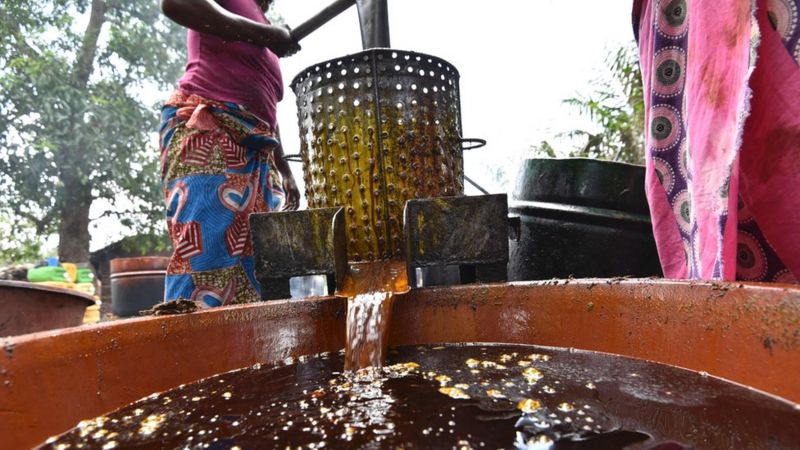
Can Cause Weight Gain
Palm oil naturally contains palmitic acid, a fatty acid that may increase your chances of weight gain and obesity. A 2005 issue of the “American Journal of Clinical Nutrition” included a study on the overall effects of a diet high in palmitic acid in healthy young adults. The study found that an increase in palmitic acid intake led to lower fat oxidation rates and a decrease in metabolism. As a result, researchers concluded that a diet high in palmitic acid may increase the chances of obesity and insulin resistance.
Choose Healthier Fats
According to Dr. Walter Willett of the Harvard School of Public Health and Amy Myrdal Miller, a registered dietitian, both writing for Harvard Health Publications, palm oil is less unhealthy for you than hydrogenated fats, which are high in trans fats as a result of the production process. However, palm oil, because it is still high in saturated fat, is considered a less healthy choice than vegetable oils that are naturally liquid at room temperature, such as olive oil or nonhydrogenated sunflower oil.
Side Effects & Safety
Palm oil is LIKELY SAFE when taken by mouth in food amounts. But palm oil contains a type of fat that can increase cholesterol levels. So people should avoid eating palm oil in excess. Palm oil is POSSIBLY SAFE when used as a medicine, short-term. Taking 9-12 grams daily for up to 6 months seems to be safe.
Special Precautions & Warnings:
Pregnancy and breast-feeding: Palm oil is POSSIBLY SAFE when taken as a medicine during the last 3 months of pregnancy. Not enough is known about the use of palm oil as medicine during breast-feeding. Stay on the safe side and stick to food amounts.
Children: Palm oil is POSSIBLY SAFE when taken by mouth as a medicine. Palm oil has been used for up to 6 months in children under 5 years of age and for up to 12 months in children 5 years of age and older.
High cholesterol: Palm oil contains a type of fat that can increase cholesterol levels. Regularly eating meals containing palm oil can increase levels of “bad” low-density lipoprotein cholesterol. This might be a problem for people who already have high cholesterol.
Sickling of red cells can increase blood coagulation and induce an increased risk of blood clot in a deep vein (DVT), or in the lung (PE) if the blood clot moves from the deep veins. People with SCD have a high chance of developing DVT or PE. DVT and PE can cause serious illness, disability and, in some cases, death.
Medications that slow blood clotting (Anticoagulant / Antiplatelet drugs) interacts with PALM OIL
Palm oil might increase blood clotting. Taking palm oil along with medications that slow clotting might reduce the effectiveness of these medications.<br><nb>Some medications that slow blood clotting include aspirin, clopidogrel (Plavix), diclofenac (Voltaren, Cataflam, others), ibuprofen (Advil, Motrin, others), naproxen (Anaprox, Naprosyn, others), dalteparin (Fragmin), enoxaparin (Lovenox) heparin, warfarin (Coumadin), and others.
Side Effects & Safety
Palm oil is LIKELY SAFE when taken by mouth in food amounts. But palm oil contains a type of fat that can increase cholesterol levels. So people should avoid eating palm oil in excess. Palm oil is POSSIBLY SAFE when used as a medicine, short-term. Taking 9-12 grams daily for up to 6 months seems to be safe.
Special Precautions & Warnings:
Pregnancy and breast-feeding: Palm oil is POSSIBLY SAFE when taken as a medicine during the last 3 months of pregnancy. Not enough is known about the use of palm oil as medicine during breast-feeding. Stay on the safe side and stick to food amounts.
Children: Palm oil is POSSIBLY SAFE when taken by mouth as a medicine. Palm oil has been used for up to 6 months in children under 5 years of age and for up to 12 months in children 5 years of age and older.
High cholesterol: Palm oil contains a type of fat that can increase cholesterol levels. Regularly eating meals containing palm oil can increase levels of “bad” low-density lipoprotein cholesterol. This might be a problem for people who already have high cholesterol.
Uses & Effectiveness
Possibly Effective for
- Preventing or treating a lack of vitamin A (vitamin A deficiency). Some evidence shows that adding a special type of red palm oil to the diets of pregnant women and children in developing countries reduces the risk of having too little vitamin A. There is also some evidence that adding this same oil to the diets of pregnant women and children who already have too little vitamin A can replace the missing vitamin A.
Possibly Ineffective for
- High cholesterol. Consuming palm oil as part of a specific diet plan does not seem to reduce cholesterol levels in people with high cholesterol. In fact, some research suggests that palm oil might actually increase cholesterol levels compared to other oils, such as soybean, canola, or sunflower oil.
- Malaria. Some research suggests that dietary consumption of palm oil by children under 5 years of age in developing countries does not seem to decrease symptoms of malaria.
Insufficient Evidence for
- Malaria. Early research suggests that eating palm oil in the diet does not seem to decrease symptoms of malaria in children under 5 years of age in developing countries.
- Anti-aging.
- Brain disease.
- Cancer.
- Cyanide poisoning.
- High blood pressure.
- Weight loss agent.
- Other conditions.
https://www.webmd.com/vitamins/ai/ingredientmono-1139/palm-oil